τεστ σήματα
Chapter 9 of 25

Meeting, overtaking and being overtaken

38 questions from the official bank with the right answer, in the order of the manual.

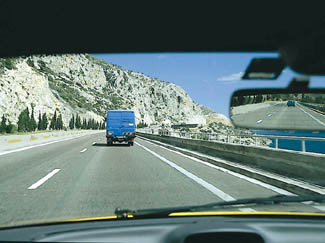
  1. No. 2
    Picture of question 2

    In this case:

    1. AYou can start overtaking.
    2. BYou have to wait to overtake after the bend.

    Right answer: A. An official question of the Ministry, in its official translation.
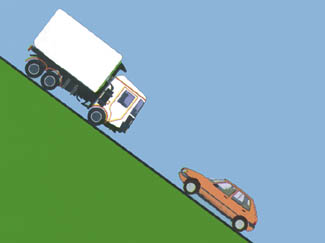
  2. No. 3
    Picture of question 3

    In this case, if reversing is necessary:

    1. AThe passenger car should reverse.
    2. BThe heavy vehicle should reverse.

    Right answer: A. An official question of the Ministry, in its official translation.
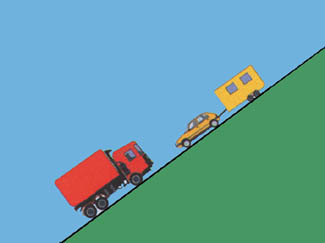
  3. No. 5
    Picture of question 5

    In this case, if reversing is necessary:

    1. AThe lorry should reverse.
    2. BThe car that tows the caravan should reverse.

    Right answer: A. An official question of the Ministry, in its official translation.
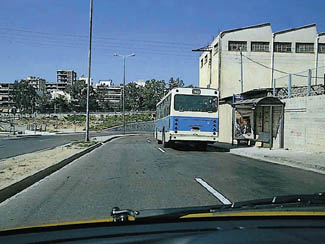
  4. No. 7
    Picture of question 7

    The bus is immobilised at the stop. You decide to overtake it, because the left lane is clear. What should you be careful about during overtaking?

    1. ALest pedestrians cross the road carelessly, passing in front of the bus.
    2. BLest the bus moves off.
    3. CLest the bus moves off or pedestrians cross the road carelessly passing in front of the bus

    Right answer: C. An official question of the Ministry, in its official translation.
  5. No. 8
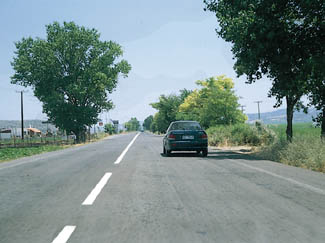
    Picture of question 8

    Your car has a good acceleration, however, in a few metres you notice a continuous line between the directions:

    1. AYou can overtake.
    2. BYou must not overtake.

    Right answer: B. An official question of the Ministry, in its official translation.
  6. No. 9
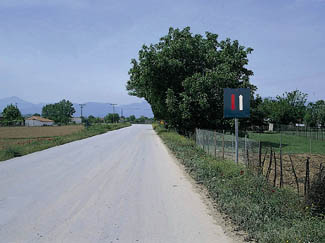
    Picture of question 9

    In this case should you give way to an oncoming vehicle?

    1. AYES
    2. BNO

    Right answer: B. An official question of the Ministry, in its official translation.
  7. No. 10
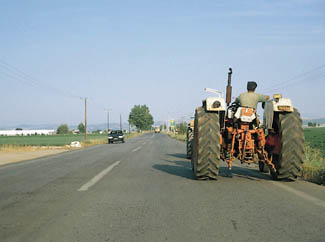
    Picture of question 10

    A vehicle is coming from the opposite direction. Should it slow down in order to allow you to overtake?

    1. AYES
    2. BNO

    Right answer: B. An official question of the Ministry, in its official translation.
  8. No. 11
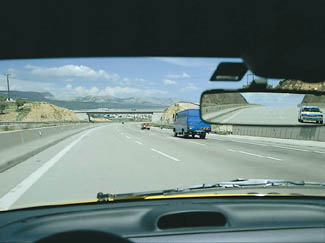
    Picture of question 11

    You are completing an overtaking. In order to return to the right lane:

    1. AYou should allow 5 seconds to pass.
    2. BYou should wait until you see the vehicle you overtook in the mirror.

    Right answer: B. An official question of the Ministry, in its official translation.
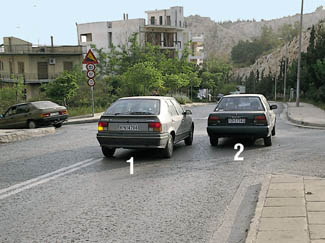
  9. No. 12
    Picture of question 12

    Vehicle 1 has its left indicator on in order to turn. Vehicle 2 has just overtaken on the right:

    1. AIt had the right to do so.
    2. BIt committed an offence.

    Right answer: A. An official question of the Ministry, in its official translation.
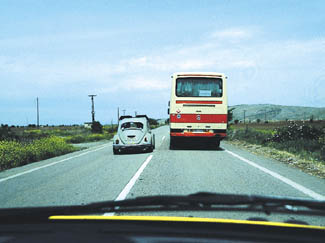
  10. No. 13
    Picture of question 13

    The visibility is excellent:

    1. AYou can follow the vehicle ahead of you that is overtaking.
    2. BYou must not follow the vehicle that is overtaking.

    Right answer: B. An official question of the Ministry, in its official translation.
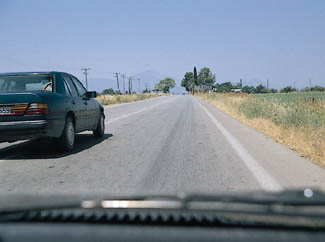
  11. No. 14
    Picture of question 14

    This vehicle is completing the overtaking of your vehicle:

    1. AYou should maintain your speed, because the overtaking was illegal.
    2. BYou should slow down slightly so as to help the other vehicle avoid the danger.

    Right answer: B. An official question of the Ministry, in its official translation.
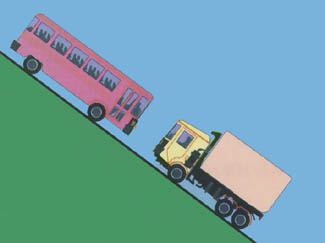
  12. No. 15
    Picture of question 15

    In this case, if reversing is necessary:

    1. AThe bus should reverse.
    2. BThe lorry should reverse.

    Right answer: B. An official question of the Ministry, in its official translation.
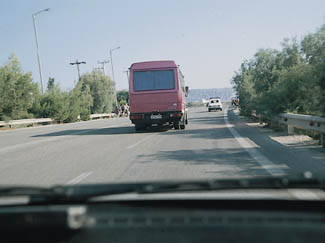
  13. No. 16
    Picture of question 16

    In this road:

    1. AYou can follow the bus that is overtaking.
    2. BYou should wait for the bus to complete the overtaking so that you overtake.

    Right answer: B. An official question of the Ministry, in its official translation.
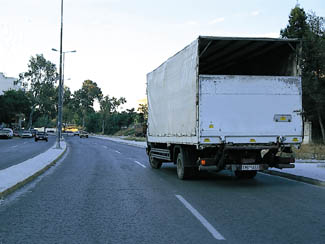
  14. No. 17
    Picture of question 17

    Can you overtake in this case?

    1. AYES
    2. BNO

    Right answer: A. An official question of the Ministry, in its official translation.
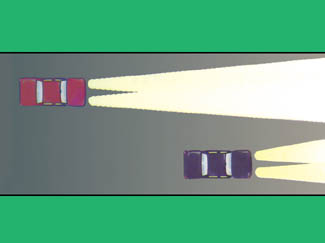
  15. No. 19
    Picture of question 19

    The red car is overtaking:

    1. AIts driver switched on the full beam headlights very early.
    2. BIts driver switched on the full beam headlights correctly.

    Right answer: A. An official question of the Ministry, in its official translation.
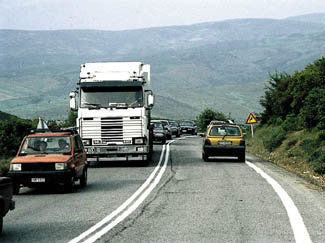
  16. No. 20
    Picture of question 20

    In this case:

    1. AIt is sensible not to overtake.
    2. BYou can overtake.
    3. CYou must not overtake.

    Right answer: C. An official question of the Ministry, in its official translation.
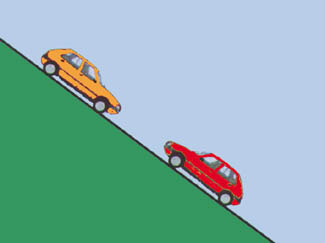
  17. No. 21
    Picture of question 21

    If necessary, must the ascending vehicle stop and reverse in order to give way to the descending car?

    1. AYES
    2. BNO

    Right answer: B. An official question of the Ministry, in its official translation.

  18. No. 24

    In order to go past a pedestrian, you should leave a side distance of at least:

    1. A0,50 m.
    2. B1 m.
    3. C1,5 m.

    Right answer: B. An official question of the Ministry, in its official translation.

  19. No. 25

    A car that is following you is ready to overtake you, while on the road there are converging arrows in your direction:

    1. AYou should slightly speed up so as to prevent this dangerous manoeuvre.
    2. BYou should maintain a steady speed and slow down, if necessary.

    Right answer: B. An official question of the Ministry, in its official translation.

  20. No. 26

    You are driving behind a lorry. In order to decide whether to start overtaking, you must:

    1. AMove slightly towards the road axis, if necessary.
    2. BGet close to its rear part in order to have better visibility.

    Right answer: A. An official question of the Ministry, in its official translation.

  21. No. 27

    If the passage of vehicles moving in opposite directions on a slope is difficult, then the vehicle which, as a rule, should stop first is the one descending:

    1. AYES
    2. BNO

    Right answer: A. An official question of the Ministry, in its official translation.

  22. No. 28

    In order to overtake an animal or a horseman, you should keep a minimum side distance of:

    1. A1 m.
    2. B0,5 m.
    3. COver 1,5 m.

    Right answer: A. An official question of the Ministry, in its official translation.

  23. No. 29

    In which of the following cases is overtaking forbidden?

    1. AIn one-way streets.
    2. BWhen the leading vehicle is going to turn right.
    3. CWhen the leading vehicle stops, in order to facilitate passage of pedestrians.

    Right answer: C. An official question of the Ministry, in its official translation.

  24. No. 30

    From which of the following vehicles, when overtaking it, should you keep longer distance for safety reasons?

    1. AFrom the lorry.
    2. BFrom the passenger vehicle.
    3. CFrom the bicycle.

    Right answer: C. An official question of the Ministry, in its official translation.

  25. No. 31

    What is your obligation when you realize that the driver of the vehicle that follows intends to overtake you?

    1. AContinue your course on the part of the road you already are, even if you can easily move to the right end of the road.
    2. BIncrease the speed of your vehicle.
    3. CMove your car as right as possible and, if necessary, slow down so that overtaking is carried out safely.

    Right answer: C. An official question of the Ministry, in its official translation.

  26. No. 32

    What should you do if, the moment you start overtaking a leading vehicle, this car speeds up?

    1. ASpeed up as well so, as to be able to overtake it.
    2. BSlow down and pull in behind the leading vehicle.
    3. CInform through the horn the driver of the leading vehicle of your intention so that they slow down.

    Right answer: B. An official question of the Ministry, in its official translation.

  27. No. 33

    What should you do in order to pass a level unguarded railway crossing?

    1. AStop the vehicle before the crossing and pass after making sure that no train is coming.
    2. BDevelop speed and pass as quickly as possible.
    3. CPass after stopping at a distance of at least 10 m from the railway lines.

    Right answer: A. An official question of the Ministry, in its official translation.

  28. No. 34

    In which case is overtaking on the right allowed?

    1. AWhen the leading vehicle has signalled that it intends to turn left and has moved to this side.
    2. BWhen the leading vehicle has not cleared the left lane.
    3. CUnder no circumstances.

    Right answer: A. An official question of the Ministry, in its official translation.

  29. No. 35

    What is the danger during overtaking even in a straight road with good visibility?

    1. AThe speed of a vehicle that is coming from the opposite direction may be estimated as low.
    2. BThe speed of a vehicle that is coming from the opposite direction may be estimated as very high.

    Right answer: A. An official question of the Ministry, in its official translation.

  30. No. 38

    In which case are you allowed to overtake a leading vehicle which is overtaking another vehicle?

    1. AOnly in one-way streets.
    2. BWhen the road has at least three lanes per direction.
    3. CUnder no circumstances.

    Right answer: C. An official question of the Ministry, in its official translation.

  31. No. 40

    Normally you are allowed to overtake only on the left. In which of the following cases are you allowed to overtake on the right?

    1. AIn rows of slow moving cars, when the traffic in your left lane is slow.
    2. BIn a road with two lanes per direction.

    Right answer: A. An official question of the Ministry, in its official translation.

  32. No. 41

    On an uphill you wish to overtake a bicycle. What should you do?

    1. APass as close to the bicycle as possible, so as not to enter the lane of the opposite direction.
    2. BKeep longer side distance, because the bicycle may start wobbling.

    Right answer: B. An official question of the Ministry, in its official translation.

  33. No. 44

    What should you be careful about during overtaking as regards the side distance?

    1. AKeeping sufficient side distance from the other road users, in particular, pedestrians and motorcyclists.
    2. BThe side distance from two-wheeled motorcycles must be shorter than that from the cars.

    Right answer: A. An official question of the Ministry, in its official translation.

  34. No. 45

    What should you do when you wish to complete overtaking?

    1. AWithout bothering the vehicle you are overtaking, return to the right side of the road as soon as possible.
    2. BSound the horn while overtaking and immediately pull in ahead of the vehicle you are overtaking.

    Right answer: A. An official question of the Ministry, in its official translation.

  35. No. 46

    Behind a lorry there is a convoy of passenger cars. Which passenger car should overtake first?

    1. AThe first passenger car of the convoy.
    2. BThe last passenger car of the convoy.

    Right answer: A. An official question of the Ministry, in its official translation.

  36. No. 49

    In which cases may a strong side wind become very dangerous?

    1. AWhen overtaking trains.
    2. BWhen passing through tunnels.
    3. CWhen passing through a dense forest.

    Right answer: A. An official question of the Ministry, in its official translation.

  37. No. 51

    Which behavioural mistake leads, when overtaking in an expressway without a traffic island, to serious accidents?

    1. ADriving at a small distance from the leading vehicle.
    2. BUnderestimation of the speed of the leading vehicles and of those coming from the opposite direction.

    Right answer: B. An official question of the Ministry, in its official translation.

  38. No. 52

    When are you allowed to start overtaking?

    1. AWhen no danger is created for the oncoming and following traffic.
    2. BWhen no danger is created for the following traffic.
    3. CWhen no danger is created for the oncoming traffic.

    Right answer: A. An official question of the Ministry, in its official translation.

Other chapters