τεστ σήματα
Chapter 10 of 25

Bends and turns

15 questions from the official bank with the right answer, in the order of the manual.

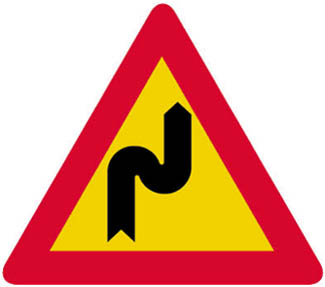
  1. No. 1
    Picture of question 1

    Does this traffic sign indicate a set of bends of which the first is left?

    1. AYES
    2. BNO

    Right answer: B. An official question of the Ministry, in its official translation.
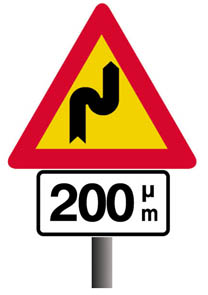
  2. No. 2
    Picture of question 2

    Does this traffic sign stress successive bends for a distance of 200 m?

    1. AYES
    2. BNO

    Right answer: B. An official question of the Ministry, in its official translation.
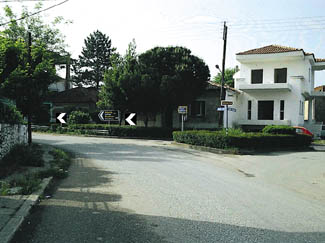
  3. No. 3
    Picture of question 3

    What should you do if you saw the traffic signs of this picture and why?

    1. AYou must move to the left, because the traffic signs indicate that left turn is compulsory.
    2. BYou must concentrate your attention slowing down if necessary, because the traffic signs warn of a dangerous curve on the left.

    Right answer: B. An official question of the Ministry, in its official translation.
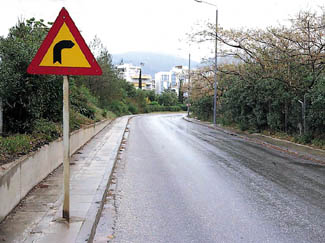
  4. No. 4
    Picture of question 4

    Why should you drive very carefully in this case?

    1. ABecause the visibility is hindered by the bend and the road is wet.
    2. BBecause after the right bend there may be a dangerous left bend.

    Right answer: A. An official question of the Ministry, in its official translation.
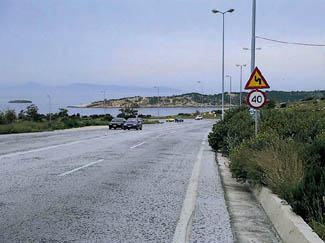
  5. No. 5
    Picture of question 5

    What do the traffic signs of the picture warn of?

    1. AAhead of you there are two dangerous converse or successive continuous bends, the first of which is left, and your speed must be restricted to 40 km/h.
    2. BBecause you will come across a branch with an oblique left road, your speed must be restricted to 40 km/h.

    Right answer: A. An official question of the Ministry, in its official translation.

  6. No. 7

    The centrifugal force:

    1. APushes your vehicle to the inside of a bend.
    2. BPushes your vehicle to the outside of a bend.
    3. CIt may be sometimes noticeable on the right side of the vehicle.

    Right answer: B. An official question of the Ministry, in its official translation.

  7. No. 8

    What affects the extent of the centrifugal force on a bend?

    1. AThe air created during the movement of the vehicle.
    2. BThe speed.

    Right answer: B. An official question of the Ministry, in its official translation.

  8. No. 9

    While you are driving on a curve the minimum speed of your vehicle must be when?

    1. AEntering the curve.
    2. BExiting from the curve.

    Right answer: A. An official question of the Ministry, in its official translation.

  9. No. 10

    On curves, if your car is overloaded:

    1. ASwerving danger is increased.
    2. BSwerving danger is reduced.

    Right answer: A. An official question of the Ministry, in its official translation.

  10. No. 11

    What should you do in sharp bends?

    1. AReduce speed before the bend and speed up only when, after the bend, you follow a straight course.
    2. BReduce speed only when you are at the top of the curve.

    Right answer: A. An official question of the Ministry, in its official translation.

  11. No. 12

    What can lead to very dangerous situations when negotiating a bend?

    1. ASteady speed within the bend.
    2. BLane change within the bend.

    Right answer: B. An official question of the Ministry, in its official translation.

  12. No. 14

    What should a driver of a vehicle that follows a heavy vehicle which intends to turn right have in mind?

    1. AThe heavy vehicle before turning will move to the left part of the road.
    2. BThe heavy vehicle will take up a position on the right part of the road.

    Right answer: A. An official question of the Ministry, in its official translation.

  13. No. 15

    Every time the speed doubles, centrifugal force:

    1. ADoubles.
    2. BTrebles.
    3. CQuadruples.

    Right answer: C. An official question of the Ministry, in its official translation.

  14. No. 16

    You are moving fast with your passenger vehicle on a bend. What may happen if suddenly you brake hard?

    1. AThe passenger vehicle will remain safe on its course.
    2. BThe passenger vehicle may deviate from the road.

    Right answer: B. An official question of the Ministry, in its official translation.

  15. No. 17

    Changing a gear within a bend is:

    1. AA proper handling.
    2. BA wrong handling.

    Right answer: B. An official question of the Ministry, in its official translation.

Other chapters