τεστ σήματα
Chapter 2 of 9

General rules of safe driving

28 questions from the official bank with the right answer, in the order of the manual.

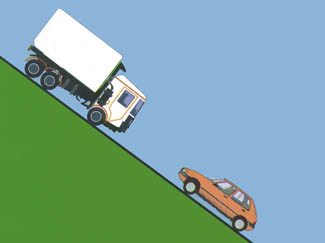
  1. No. 1
    Picture of question 1

    In this case, if reversing is necessary:

    1. AThe passenger car should reverse.
    2. BThe heavy vehicle should reverse.

    Right answer: A. An official question of the Ministry, in its official translation.
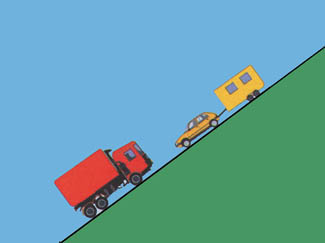
  2. No. 2
    Picture of question 2

    In this case, if reversing is necessary:

    1. AThe lorry should reverse.
    2. BThe car that tows the caravan should reverse.

    Right answer: A. An official question of the Ministry, in its official translation.
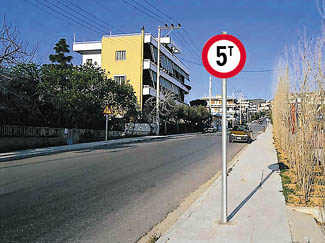
  3. No. 3
    Picture of question 3

    To which vehicles is entry forbidden?

    1. AAll vehicles whose trailer is heavier than 5 tons.
    2. BAll vehicles with a total weight of over 5 tons.

    Right answer: B. An official question of the Ministry, in its official translation.
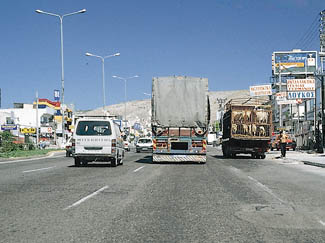
  4. No. 4
    Picture of question 4

    You are driving a lorry in a motorway with three lanes per direction:

    1. AYou should drive in the two rightmost lanes.
    2. BYou should drive in any lane due to the heavy traffic.

    Right answer: A. An official question of the Ministry, in its official translation.
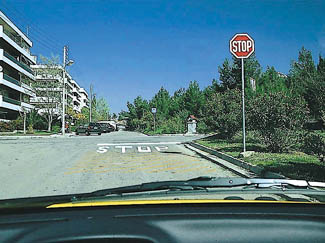
  5. No. 5
    Picture of question 5

    What should you do in this case?

    1. AMove up to the stop line, stop and, after checking that no vehicles are coming vertically, to which you have to give priority, go on.
    2. BMove up to the STOP sign, stop there and give priority to the vehicles coming vertically. As long as you do not see any vehicles coming, cross the intersection.

    Right answer: A. An official question of the Ministry, in its official translation.
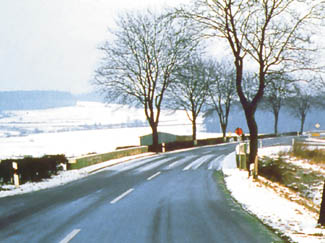
  6. No. 7
    Picture of question 7

    The ice is:

    1. AUsually distributed uniformly on the road.
    2. BFormed mainly in mountainous areas, bridges and near water currents.
    3. CFormed mainly in foggy days.

    Right answer: B. An official question of the Ministry, in its official translation.
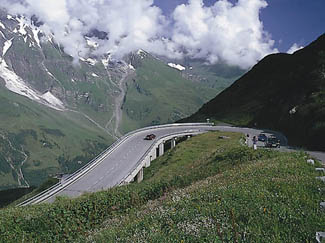
  7. No. 8
    Picture of question 8

    On the mountain on sharp bends:

    1. AYou should move as right as possible within your direction.
    2. BYou should always sound the horn.

    Right answer: A. An official question of the Ministry, in its official translation.

  8. No. 9

    A two-way street is divided by two white continuous lines. Are you allowed to cross them?

    1. ANo, not in any circumstances.
    2. BYes, if there is good visibility and you have checked the opposite direction.
    3. CYes, if the leading vehicle is moving at a very low speed.

    Right answer: A. An official question of the Ministry, in its official translation.

  9. No. 10

    A two-way street is divided by one white continuous line. Are you permitted to cross it?

    1. AYes, if no vehicles are coming from the opposite direction.
    2. BNo, not in any circumstances.
    3. CYes, if you intend to overtake another vehicle that is moving at a low speed.

    Right answer: B. An official question of the Ministry, in its official translation.

  10. No. 12

    On which factors does the stopping distance depend mainly?

    1. AThe length and weight of the vehicle and the pressure exerted on the footbrake pedal.
    2. BDriver’s reaction time, condition of the brakes, pressure on the footbrake pedal, condition of the tyres, surface and condition of the road (wet, etc.).
    3. CDriver’s reaction time and wind speed.

    Right answer: B. An official question of the Ministry, in its official translation.

  11. No. 14

    In order to go past a pedestrian, you should keep a side distance of at least:

    1. A0,50 m.
    2. B1 m.
    3. C1,5 m.

    Right answer: B. An official question of the Ministry, in its official translation.

  12. No. 15

    What should you do, if you realize that the driver of the vehicle that follows intends to overtake you?

    1. AContinue your course on the part of the road you are moving, even if you can easily move to the right edge of the road.
    2. BSpeed up.
    3. CBring your vehicle as right as possible on the road, and if necessary, slow down so that the other vehicle overtake you safely.

    Right answer: C. An official question of the Ministry, in its official translation.

  13. No. 16

    In which of the following cases is overtaking forbidden?

    1. AImmediately before or while on a level unguarded railway crossing without mobile barriers, unless traffic is regulated by traffic lights.
    2. BWhen the leading car is going to turn right.
    3. CIn two-way streets with a single lane per direction.

    Right answer: A. An official question of the Ministry, in its official translation.

  14. No. 17

    Somebody is overtaking you and you notice that there are conditions of an impending accident with a vehicle moving in the opposite direction. You should:

    1. AReduce speed so that the vehicle that is overtaking you pulls in ahead of you.
    2. BIncrease speed so that the vehicle that is overtaking you pulls in behind you.
    3. CIncrease speed and sound the horn so as to warn the other drivers.

    Right answer: A. An official question of the Ministry, in its official translation.

  15. No. 21

    If you notice that a vehicle from the opposite direction is coming on you due to a breakdown or other cause, how should you react?

    1. AYou should continue your course.
    2. BYou should try, moving to the right if possible, to get out of the course of the vehicle, sounding continuously the horn and flashing your lights.
    3. CYou should sound continuously the horn and flash your lights.

    Right answer: B. An official question of the Ministry, in its official translation.

  16. No. 24

    Half of the road is closed due to a worksite. Two vehicles are reaching simultaneously the worksite from opposite directions. Which vehicle should wait?

    1. AThe smaller vehicle.
    2. BThe wider vehicle.
    3. CThe vehicle that is moving in the lane where the obstacle is.

    Right answer: C. An official question of the Ministry, in its official translation.

  17. No. 26

    A slow moving vehicle is followed by many vehicles, which due to the traffic circumstances cannot overtake it. What should the driver of the slow moving vehicle do?

    1. AMaintain their speed.
    2. BSlow down when appropriate and wait, if necessary, so that the vehicles that follow be able to overtake.
    3. CTake the first turning.

    Right answer: B. An official question of the Ministry, in its official translation.

  18. No. 27

    During driving you ascertain that you have lost control of the car, because there are oils on the asphalted road. What should you do?

    1. ASlow down applying the brakes.
    2. BRelease the accelerator pedal and change into a lower gear.
    3. CPress the accelerator pedal and correct your course through the steering-wheel.

    Right answer: B. An official question of the Ministry, in its official translation.

  19. No. 28

    When approaching a bend, what should you do so that your car does not slide or swerve from its lane?

    1. APress the footbrake pedal when within the bend.
    2. BMaintain the speed at which you are reaching the bend.
    3. CSlow down before the beginning of the bend.

    Right answer: C. An official question of the Ministry, in its official translation.

  20. No. 29

    When are you allowed to reverse your vehicle?

    1. ANear a lamp post.
    2. BWhen it is not possible to move ahead or when you manoeuvre for parking.
    3. CFrom a central road to a side road.

    Right answer: B. An official question of the Ministry, in its official translation.

  21. No. 30

    You wish to turn left. What are the procedures to be followed?

    1. ASwitch on the direction indicator, take up the correct position on the road and check the vehicles that follow.
    2. BCheck the vehicles that follow, switch on the direction indicator and take up the correct position on the road.
    3. CTake up the correct position on the road, switch on the direction indicator and check the vehicles that follow.

    Right answer: B. An official question of the Ministry, in its official translation.

  22. No. 34

    Every time you overtake a vehicle at night and you are allowed to turn on the full beam headlights, you should do this:

    1. ABefore moving to the left.
    2. BWhen you are on the left and before reaching the level of the other vehicle.
    3. CWhen you are at the same level with the other vehicle.

    Right answer: C. An official question of the Ministry, in its official translation.

  23. No. 35

    When you drive in roads with ice, the distance normally required for stopping in case of emergency compared to that required when the road is dry may be increased by?

    1. ATwice.
    2. B5 times.
    3. C10 times.

    Right answer: C. An official question of the Ministry, in its official translation.

  24. No. 36

    What should you know with regard to road condition, when it starts to rain and in particular, after a long period of drought?

    1. AThe layer of sludge at the beginning of the rain is not dangerous.
    2. BThe layer of sludge at the beginning of the rain is dangerous.
    3. CThe layer of sludge does not affect tyre grip on the road.

    Right answer: B. An official question of the Ministry, in its official translation.

  25. No. 39

    How can you profit the best from the braking effect of your engine at a long and steep downhill?

    1. ABy selecting a higher gear in good time.
    2. BBy selecting a lower gear in good time.
    3. CBy selecting the neutral gear in good time.

    Right answer: B. An official question of the Ministry, in its official translation.

  26. No. 41

    When driving on a long steep downhill, you should control the speed of your vehicle by:

    1. AApplying the footbrake throughout the downhill.
    2. BEngaging a lower gear before the downhill, and applying the footbrake at intervals.
    3. CApplying the footbrake and engaging a lower gear as you are approaching the end of the downhill.

    Right answer: B. An official question of the Ministry, in its official translation.

  27. No. 43

    Which way of driving is very economical and contributes to environmental protection?

    1. AChange into the just higher gear in good time.
    2. BDriving using up the number of revolutions for every gear.
    3. CChange into the higher gear in good time at the beginning of an uphill.

    Right answer: A. An official question of the Ministry, in its official translation.

  28. No. 44

    What are the requirements for economical driving and reduced emission of exhaust gases?

    1. AA well maintained and properly regulated engine.
    2. BQuick start and hard acceleration.
    3. CTyre pressure that is lower than the normal.

    Right answer: A. An official question of the Ministry, in its official translation.

Other chapters