τεστ σήματα
Chapter 12 of 25

Following a route

28 questions from the official bank with the right answer, in the order of the manual.

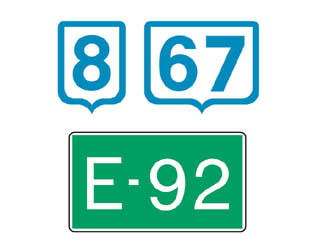
  1. No. 1
    Picture of question 1

    Can you find the same indications on traffic signs showing directions and on road maps?

    1. AYES
    2. BNO

    Right answer: A. An official question of the Ministry, in its official translation.
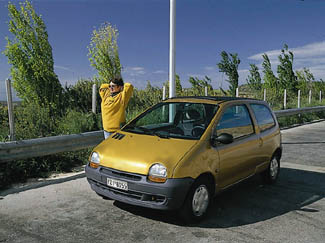
  2. No. 3
    Picture of question 3

    You should take breaks:

    1. AEvery 500 km.
    2. BEvery two hours.

    Right answer: B. An official question of the Ministry, in its official translation.
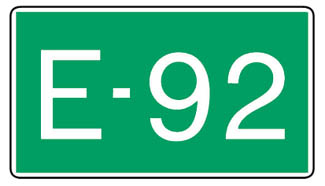
  3. No. 4
    Picture of question 4

    The traffic sign E-92 on a green background means?

    1. AExit at an angle of 92°.
    2. BInternational artery 92.
    3. CHighway 92.

    Right answer: B. An official question of the Ministry, in its official translation.
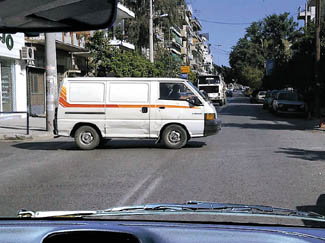
  4. No. 6
    Picture of question 6

    You intend to move straight, but the white car has stopped at a bad point waiting to cross the road and has blocked a part of your lane. What should you do?

    1. AYou should stop and give way to the white vehicle so as that it clears the road.
    2. BYou should speed up and pass between the white car and the pavement.

    Right answer: A. An official question of the Ministry, in its official translation.
  5. No. 7
    Picture of question 7

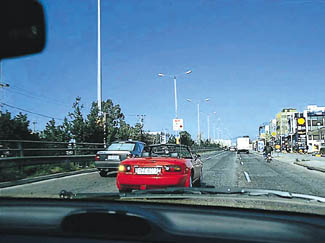
    The driver of the red passenger car has switched on the left indicator, because they intend to move to the left lane in which another car is preceding. What should they do?

    1. ASpeed up and, after overtaking the leading car on the right, pull in the left lane.
    2. BSlow down, check behind them whether the left lane is clear and enter it following the leading car.

    Right answer: B. An official question of the Ministry, in its official translation.
  6. No. 8
    Picture of question 8

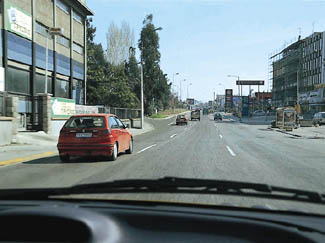
    You are moving in the middle lane in the road of the picture and you intend to turn left at the next crossroads. What should you do?

    1. ASpeed up, overtaking the red car inform its driver of your intention, and turn left.
    2. BInform the drivers that follow of your intention, check the traffic in the left lane and pull in gradually behind the red car.

    Right answer: B. An official question of the Ministry, in its official translation.
  7. No. 9
    Picture of question 9

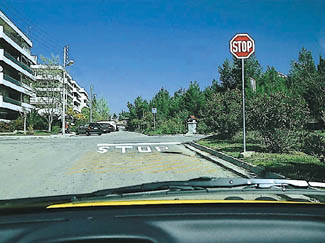
    What should you do in this case?

    1. AMove up to the STOP line, stop and, after making sure that no other vehicles are coming vertically to you, to which you must give priority, go on.
    2. BMove up to the STOP traffic sign, stop there and give priority to the vehicles that are coming vertically to you. When no other vehicles are coming, cross the intersection.

    Right answer: A. An official question of the Ministry, in its official translation.
  8. No. 12
    Picture of question 12

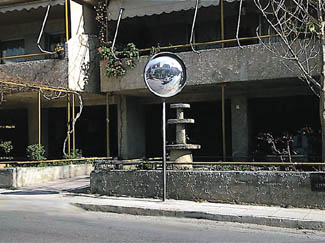
    What is the aim of the mirror in the picture?

    1. ATimely ascertainment of the movement of vehicles in an oblique or vertical road where there is no visibility.
    2. BIndication of a crossroads where priority from the right applies.

    Right answer: A. An official question of the Ministry, in its official translation.
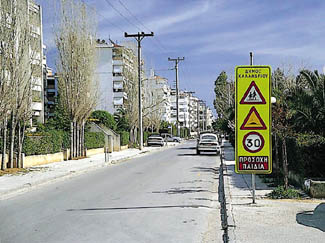
  9. No. 14
    Picture of question 14

    How should you drive in this case?

    1. ACarefully due to the danger from the frequent passage of children, and at a speed not lower than 30 km/h.
    2. BCarefully due to the danger from the frequent passage of children, and at a speed not higher than 30 km/h.

    Right answer: B. An official question of the Ministry, in its official translation.

  10. No. 17

    For long drives you should mainly follow the directional traffic signs with a:

    1. ABlue and green background.
    2. BWhite background.

    Right answer: A. An official question of the Ministry, in its official translation.

  11. No. 22

    In order to complete a journey of about 500 km at an average speed of 100 km/h, you will approximately need:

    1. A4 hours.
    2. B5 and a half hours at least.
    3. C5 hours.

    Right answer: B. An official question of the Ministry, in its official translation.

  12. No. 23

    In which of the following cases must you ease down the speed of your vehicle?

    1. AOn steep downhills.
    2. BWhen overtaking another vehicle, you are next to it.
    3. CWhen you start overtaking another vehicle.

    Right answer: A. An official question of the Ministry, in its official translation.

  13. No. 25

    When you are going to leave a square, must you inform those that follow by using the indicators?

    1. AYES
    2. BNO
    3. CNo, provided that traffic signs determine a compulsory circular movement.

    Right answer: A. An official question of the Ministry, in its official translation.

  14. No. 28

    During driving you realize that you have lost control of the car because there is oil on the road surface. What should you do?

    1. ASlow down applying the brakes.
    2. BRelease the accelerator pedal and engage a lower gear.
    3. CPress the accelerator pedal and correct the course through the steering-wheel.

    Right answer: B. An official question of the Ministry, in its official translation.

  15. No. 29

    How long is the load allowed to jut out from the rear part of a passenger car with a body of 4 m long?

    1. A0,50 m at most.
    2. B1,80 m at most.
    3. C1,20 m at most.

    Right answer: C. An official question of the Ministry, in its official translation.

  16. No. 31

    If in your passenger car there are children up to 12 years old, how should they be carried safely?

    1. AOn any seat (front or rear).
    2. BOnly on the rear seats.
    3. COnly on the rear seats through the use of supporting devices of an approved type (seat belts, child seats, etc.).

    Right answer: C. An official question of the Ministry, in its official translation.

  17. No. 33

    Why is it dangerous to accelerate hard during starting?

    1. ABecause the driving wheels may lock.
    2. BBecause the driving wheels may spin and due to that stones and other objects may be ejected to the vehicles that follow.

    Right answer: B. An official question of the Ministry, in its official translation.

  18. No. 34

    How should a driver warn the other vehicles of the failure of his/her vehicle while he/she is moving and must immobilise it?

    1. AHe/she must switch on the hazard warning lights.
    2. BHe/she must switch on the side lights.

    Right answer: A. An official question of the Ministry, in its official translation.

  19. No. 35

    What are the consequences of carrying luggage on the roof of your passenger car?

    1. ACar stability is reduced within the bend.
    2. BCar stability against side winds is increased.
    3. CThe driving behaviour of the vehicle is improved due to the raising of the centre of gravity.

    Right answer: A. An official question of the Ministry, in its official translation.

  20. No. 36

    Why is it dangerous to accelerate hard during starting?

    1. ABecause the driving wheels may spin and the vehicle may slide laterally in a slippery road.
    2. BBecause the driving wheels may lock.

    Right answer: A. An official question of the Ministry, in its official translation.

  21. No. 37

    When are you allowed to reverse your vehicle?

    1. ANear a lamp-post.
    2. BWhen forward movement is not possible or during a parking manoeuvre.
    3. CFrom a main road to a side road.

    Right answer: B. An official question of the Ministry, in its official translation.

  22. No. 38

    You are driving at night having the headlights on full beam. When must you switch on the dipped headlights?

    1. AWhen pedestrians are preceding in the same direction.
    2. BWhen a vehicle is preceding at a small distance.

    Right answer: B. An official question of the Ministry, in its official translation.

  23. No. 39

    Your passenger vehicle is skidding during braking. How should you react?

    1. ARelease the brakes and turn the steering-wheel to the opposite direction, that is to the direction of vehicle rear part skidding.
    2. BBrake harder and do not turn the steering-wheel at all.

    Right answer: A. An official question of the Ministry, in its official translation.

  24. No. 40

    Humidity may adversely affect brakes' effectiveness. What should you do in this case?

    1. ABrake many times while the vehicle is stopped.
    2. BMove at a low speed and brake repeatedly and softly.
    3. CFill in brake fluid.

    Right answer: B. An official question of the Ministry, in its official translation.

  25. No. 44

    You are driving in a provincial road in a convoy of cars. What should you do?

    1. ABy using the horn and the lights urge the leading vehicle to overtake.
    2. BKeep sufficient distance from the leading vehicle and watch the vehicle that follows.
    3. COvertake as fast as possible the leading vehicles one after the other.

    Right answer: B. An official question of the Ministry, in its official translation.

  26. No. 45

    You have a vehicle that leaves much dirt on the road. What should you do?

    1. AIt suffices to call the traffic help.
    2. BSpot the dangerous point and remove the dirt, and, if this is not possible, call Traffic Police.
    3. CYou do not need to do anything.

    Right answer: B. An official question of the Ministry, in its official translation.

  27. No. 46

    Which parts of the road are you not permitted to enter, if due to traffic jam you had to wait?

    1. AIntersections, railway crossings, pedestrian crossings.
    2. BMotorways, expressways.

    Right answer: A. An official question of the Ministry, in its official translation.

  28. No. 47

    In which cases may a motor vehicle swerve laterally on a dry and straight road?

    1. AWhen hit by a strong air current while moving at a high speed.
    2. BWhen accelerating moderately.
    3. CWhen slowing down moderately.

    Right answer: A. An official question of the Ministry, in its official translation.

Other chapters